Sunday, January 13, 2013

Forces in 2D


BIG QUESTIONS:

1. What does it mean to analyze forces in 2D? 

In 2D, analyzing forces means breaking up the forces into two dimensions: an X-component and a Y-component. Next we have to solve for the x and y components using Sine( to solve for Y) or Cosine( to solve for X) also known as SOH CAH. Lastly we solve for the net force for the x and y components by adding up both all the x components and y components SEPARATELY.


Lab:
In a few of our practice problems during class we solved for the x and y components just like in the picture below. Once we solved for the x and y components we added all of them up to calculate the Fnet-x and Fnet-y. During these practice problems I learned that the x and y components can be negative or positive depending on what direction they are going in.


Reminder: 
- When solving for the x and y components remember they are vectors so they can be POSITIVE and NEGATIVE lines
-In a 2D problem we are dealing with TWO FORCES so we have to solve for both of them SEPARATELY


2. How do forces cause objects to move in a circle? 

During the hover disc lab, we swung the disc around in a circle making ourselves the center and applied a centripetal force using a rope. Centripetal force is a force that is necessary to keep an object moving in a curved path and is a force directed inward toward the center of rotation. This means that the hover disc is accelerating at a constant speed, but in a different direction. If we were to let go of the rope, the hover disc went in a straight line tangent to the previous circle it was moving in. To help explain why this happens we refer back to Newton's First Law: an object will stay at rest or keep moving at a constant speed unless there is a net force applied.


3. What does it mean to be in orbit? How do satellites orbit planets and how do planets orbit the sun? 

To be in orbit means to travel in a circular path around another. The satellites orbit planets with the same idea as the hover disc, centripetal force. The satellite is being pulled toward the Earth just like in the hover disc lab. The Earth is the center of this circle and the satellite is circling or orbiting around it. Same thing goes for the planets, the planets are orbiting the sun just like how the satellite orbits earth and how the hover disc orbited us except on a bigger scale. The sun is applying a centripetal force on the earth to keep it moving in a circular path and not crash into other planets. Now if the sun were to disappear the Earth and every other planet orbiting it would travel in a straight line tangent to the previous circle it was traveling in.

This picture illustrates the circular path that the planets travel in around the sun or how the planets orbit the sun.


Sunday, November 18, 2012

Newton's Laws of Motion

Over the last week or two, our class covered all Three of Newton's Laws of Motion. We learned about his laws by performing two in class labs, doing a ton of practice problems, and from in class notes.

Our first lab was the HOVER DISC lab. In this lab we went down into the  gym foyer and performed several different scenarios using a hover disc. In groups of three we looked at these different scenarios to see what kind of forces  were taking effect. The picture below is an example of what my group and I did in the gym foyer. Also the two diagrams are the forces taking effect in this specific scenario. This lab allowed us to examine Newton's Third Law of Motion. This law states that when two objects interact, they exert equal and opposite forces on each other.

Interaction Diagram
   An interaction diagram, like the one below, allows us to analyze ALL the force on MANY objects. For example Person 2 is pushing the disc, meaning that Fn( Normal force) is taking place and there is Fg( Gravitational Force) between the disc, person 2, person 1, and the Earth.

Free Body Diagram
  A free body diagram, like the one beneath the interaction diagram, allows us to take analyze ALL forces on ONE object. In this free body diagram we are looking more closely at the disc and the types of forces being applied on it. A free body diagram allows us to show the magnitude and direction of the forces being applied, which really helps when your trying to solve an acceleration problem.


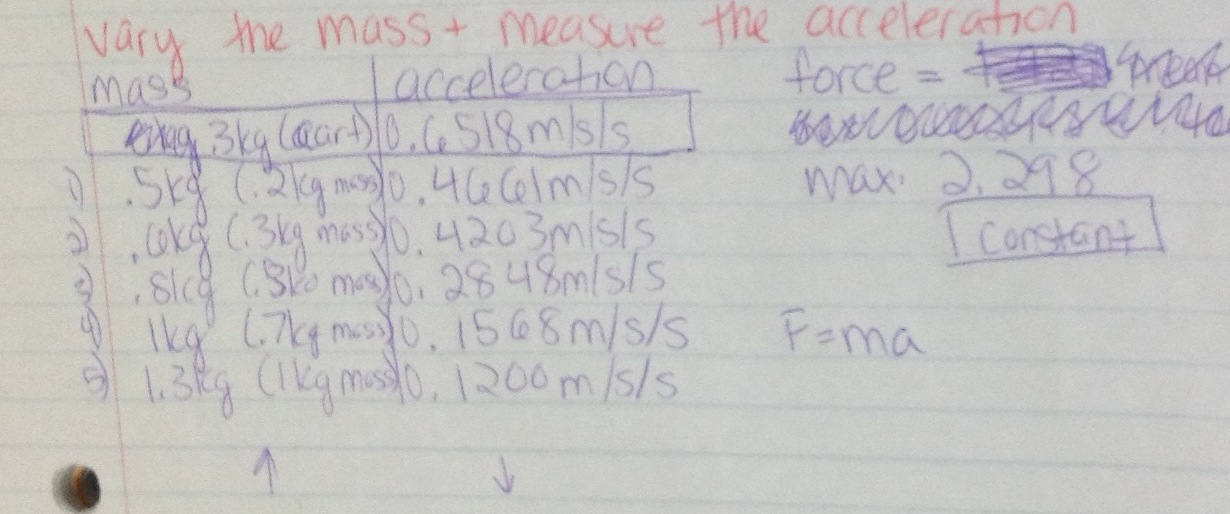
After we performed another lab, a Fan Cart Lab. In this lab our goal was to find the relationship between mass, acceleration, and force. We did this by turning on  a Fan Cart and letting it hit against a piece of aluminum on a force probe in order to get a constant force of about 2N( newtons). 

Next we used the logger pro program on the computer to get a time vs velocity graph. This graph gave us the slope of the change in velocity over the change in time which happens to be acceleration. 


Then we added a series of weights on the fan cart to help us find the relationship between acceleration and mass. We realized that mass and acceleration are  inversely proportional then we asked ourselves " what if we multiplied these mass and acceleration together," so we tried it out.


 Once we multiplied them together we were shocked to find out that it equaled the constant force we got during the beginning of the lab which as 2N. This helped us derive and equation the relates mass, acceleration, and force which is:

Force = (mass) (acceleration)
Later as we took notes in class, we found out that the equation above is also Newton's Second Law of Motion.  We can also understand Newton's First law of Motion by looking back at both of these labs. His first law states that an object at rest or traveling at a constant speed will continue to do so, unless a net force acts on it. Now just to recap everything we learned and sum it up,the picture below describes all three of Newton's Laws of Motion.


~Real World Connection~
A real world situation where all three of Newton's Laws take place could be a soccer game.

Newton's First Law of Motion:  A soccer player could kick a ball and it will keep going straight unless another player hits it or the friction between the ball and the earth reduces the ball's acceleration.

Newton's Second Law: Just kicking the ball itself could be an example for this law but to make things interesting soccer could also demonstrate how mass and acceleration are inversely proportional. If it were to rain the soccer ball would get heavier( increase in mass) making it harder for a soccer player to kick the ball farther or faster (decrease in acceleration)

Newton's Third Law: If a soccer ball hits a soccer player they would both exert the same but opposite amount of force. The reason why the ball bounces off the soccer player though is due to the difference in mass between the two.


Monday, October 29, 2012

Impulse Lab


BIG QUESTION:
What is the relationship between impulse, force, and time in a collision?

 Newton once claimed that  " For every force there is an equal opposite of force."

Lab:
In this lab we made a collision between a sonic probe and a cart, both with an aluminum ring attached to help us see how time manipulates force.


After we collected our data we found out that the change in both force and momentum( Impulse)  were relatively close. We got this by finding the change in momentum and also by finding the area of a force x time graph. As you can see in the picture below J ( impulse) =-.319 is pretty close the area of the graph T(F)= -.3768.
Because these two are really close ato being the same data this means that a force x times graph  represents the impulse .

The next part of our lab we observed a collision between two carts, one weighing more than the other ( blue cart weighing more) . We later found out that these two carts both bent the same amount even though one cart( the blue cart) weighed more. Now you can conclude that  NO MATTER WHAT THE MASS THERE IS AN EQUAL  AND OPPOSITE FORCE.  

Recently Asked Questions:
Why does the red cart fly back farther than the blue cart?
  • The red cart flies back due fact that the blue cart has a bigger mass which means there will be a bigger difference in momentum between the red and blue cart.
  • The aluminum rings doesn't affect why the red cart flies back because it doesn't change and it will have the same amount of force as the blue cart
Why do both the aluminum rings bend the same amount?

  • They bend the same amount because the only thing that changed was the mass which doesn't affect the force or time in this situation

Real Life Connection
Rock climbing is the best way to think about an impulse lab for me. In rock climbing when a climber comes down a cliff, they use a rope to help INCREASE the amount of stopping time  and DECREASE the amount of force. This is a really big deal to climbers because if they couldn't increase the amount of stopping time then the force could be great enough to kill them. I think climbers really appreciate physics every time the choose to go climb.

Sunday, October 28, 2012

Collisions Lab


Big Questions:
1. What is the difference between the amount of energy lost in an Elastic vs. Inelastic collision?
2. What is a better conserved quantity? Momentum or energy?


In this week's lab, our main goal was to try and find out whether momentum or energy is better conserved and why. We started this lab by doing an elastic and inelastic collision to see how momentum and kinetic energy changed.   

First we did an inelastic collision. An inelastic collision is when one object collides with another and they both travel in the same direction. After we performed an elastic collision. An elastic collision is when to objects collide and they both travel in two separate directions. During both these collisions we used a sonic range finder that measures sound so we could find the velocity before and after the collision.


Once we collected all our data, we then figured out the percent difference which is the change in energy or momentum. Looking at the percent differences of both inelastic and elastic collisions, made us realize that momentum has a lower percent difference, meaning that
 momentum is better conserved during any collision no matter elastic or inelastic.


Inelastic Collision's Percent Difference
Elastic Collision's Percent Difference


Real World Connection
 A good real life connection would be golf. Golf is a well known sport and is watched by tons of people around the world. This would be a great example for an elastic collision. During golf the golf club hits a golf ball, energy is then transfered from golf club to the ball. In the process though the ball loses some energy due to factors such as wind.


Rubber Band Cart Launcher

BIG QUESTION:
-How are energy and velocity related?


Two weeks ago we found out the relationship between mass, height, and gravity, to derive an equation using them, and find different way of finding potential energy in order to find velocity.  We continued to use  elastic potential energy in our lab while we tried to find the velocity of the red cart. We found this by launching the cart through a photo gate sensor and by doing a series of  trials,  for the most accurate data. We used a program called Graphical Analysis to create a graph that best represented our data.
From this lab I learned that velocity and energy are directly proportional, which means if you increase velocity you also increase the energy. I also learned that energy is conserved throughout the system which means it stays the same. The energy is just transferred from elastic potential energy to kinetic energy. In this lab we derived the equation K=1/2(m)(v)^2. which helps describes how energy and velocity are directly proportional.

Real Life Connection:
     A connection I can make to the real world would be a sling shot. When using a sling shot you are pulling back on an object with a rubber band( Elastic potential energy) and the farther you pull it back the more energy it gains. Then when you release the object the energy from the rubber band is transferring into velocity but not losing any energy. Kinetic energy is just replacing the elastic potential energy.

Sunday, September 23, 2012

Rubber Band Lab


BIG Question!

How does the force it takes to stretch a rubber band depend on the AMOUNT by which you stretch it?

Lab Time

In this lab, we wrapped a rubber band over prongs then we pulled it to different lengths (such as 1 cm, 2cm, 3cm, etc)with the electronic force probe. The first time we pulled the rubber band to the different lengths it was just a single-looped rubberband but then the second time, there were two loops. We did this to see if there would be any drastic changes to our data. The data we got from our single looped rubber band looked a little like this: 
1 cm = 0.38 N
2 cm = 1 N
3 cm = 1.9 N
4 cm = 2.7 N
5 cm = 3.5 N

While our double looped rubber band looked like this:
1 cm = 3.1 N
2 cm = 5.3 N
3cm = 8.4 N
4 cm = 11 N
5cm = 12.6 N

We noticed that by double looping the rubber band that there was an increase in force even though we didn't change how far we pulled the rubber band.

Next, we had to create an equation relating the rubber band, the distance we stretched it, and the force need to stretch it. We found an equation by graphing our data and coming up with a best fit line on a graph where the x-axis is the distance in meters and the y-axis is the force in newtons. 
After all this we came up with the equation Fs=kx.
Fs=Force need to stretch the rubberband
K=Elastic constant of the rubber band
X=the distance stretched

Lastly, we wanted to find the energy/work used in this lab. Just like in our simple machines lab we wanted to find the area of the graph which is also the energy but in this lab the area would be different. The area for this lab is in the shape of a triangle so we had to use the forumla to find a triangle which is Area=1/2(Base)(Height)[A=1/2BH] . We used this forumla and just substituted in our first equation Fs=kx. Our area would be equivalent to Us(elastic potential energy, our base equal to "x" and our height equal to "Fs."We later found out that we couldn't use Fs in our new equation so we changed it to "kx." Afterwards we came to the conclusion that the equation to find the elastic potential energy is Us=1/2(k)(xsquared).

Finally we are done with the lab and now know that force is directly proportional to distance, which is the answer to our big question.

Real World Connection
I think bungie jumping is a great example for this lab. When you bungie jump you are stretching a rope "x" amount of distance depending on how much you weigh which is also the force need to stretch the rope.  The more you weigh the farther you will go down meaning that is directly proportional just like our rubber band lab. This is why when you bungie jump they need to know how much you weigh so that they can increase or decrease the amount of rope your using because if they use a long piece of rope and you stretch the rope too much then you might hit the ground leading to serious injury.


Sunday, September 16, 2012

Pyramid Lab


Big Question: 

Is the product of force and distance universally conserved (a constant in systems other than pulleys)?

Lab

To start off this lab, we pulled a toy car up a 12cm(vertically) ramp while adding different masses and making the distance of the ramp shorter and longer. The car it self was 250g and we kept adding masses of 250g on it throughout the lab. For our first trial we pulled just the car(250g) up to 9cm  and it took 2.5 Newtons. We then added a mass of 250g to the car so it weighed 500g together. After we pulled the car of 500g up to 166cm and we got a total of 1 Newton to pull the car that long distance. This is when my group started to question what we were doing. We were unsure on what we were "supposed" to get during the lab but we just kept recording data and eventually figured it out. Finally we came up with the conclusion that if we changed the mass of the car or how far we pulled the car on the ramp, we would always end up with the same amount of energy.

uploaded image
A visual drawing of what the experiment looked like
D=distance
M=Mass(the car)
F= Force need to pull/push the mass a certain distance

Real World Connection

Handicap ramps and the great pyramids of egypt use this idea of having a ramp to use less force. Handicaps need these ramps because they can't put pressure or force on their legs(less force) so they have to travel up this ramp (more distance).  These ramps are a real life save for them, it allows them to get to places where they would usually have to walk up stairs. Having a ramp saves time for handicaps and also allows them to put in less effort, making their lives easier.